There’s been understandable concern about medical ethics after the Pathways puberty blocker trial was passed as meeting “rigorous scientific and ethics standards”. Giving powerful chemical castration drugs to vulnerable young children, ethical?
But then you look at the stuff that gets published in the Journal of Medical Ethics….
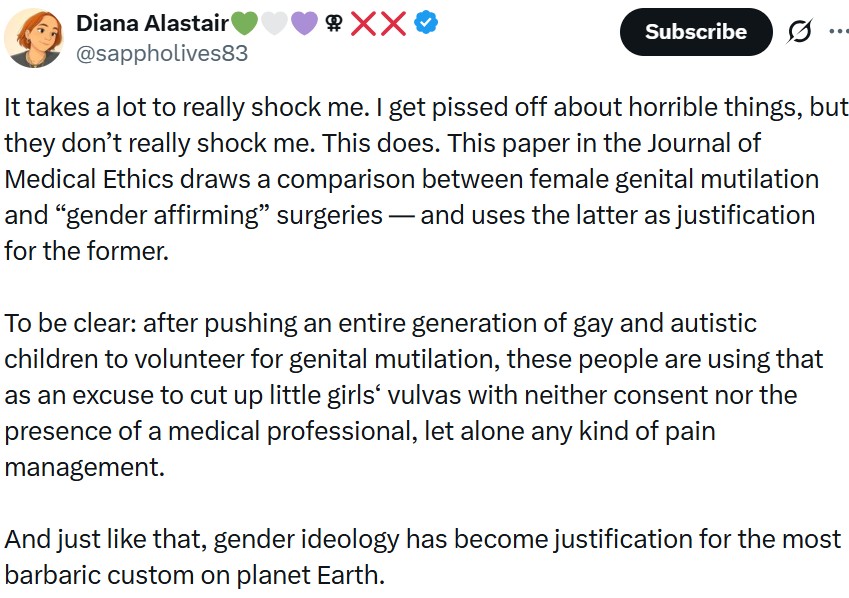
Article here. The abstract.
Traditional female genital practices, though long-standing in many cultures, have become the focus of an expansive global campaign against ‘female genital mutilation’ (FGM). In this article, we critically examine the harms produced by the anti-FGM discourse and policies, despite their grounding in human rights and health advocacy. We argue that a ubiquitous ‘standard tale’ obscures the diversity of practices, meanings and experiences among those affected. This discourse, driven by a heavily racialised and ethnocentric framework, has led to unintended but serious consequences: the erosion of trust in healthcare settings, the silencing of dissenting or nuanced community voices, racial profiling and disproportionate legal surveillance of migrant families. Moreover, we highlight a troubling double standard that legitimises comparable genital surgeries in Western contexts while condemning similar procedures in others. We call for more balanced and evidence-based journalism, policy and public discourse—ones that account for cultural complexity and avoid the reductive and stigmatising force of the term ‘mutilation’. A re-evaluation of advocacy strategies is needed to ensure that they do not reproduce the very injustices they aim to challenge.
The anti-FGM campaign is based on “misleading, often racialised, stereotypes.” It’s fine, really, girls getting parts of their genitals surgically removed. It’s all about aesthetic enhancement….
Added: ooh, it’s made the Times – Criticism of FGM based on ‘western sensationalism’, say academics.
The phrase female genital mutilation is “stigmatising” to certain cultures and should be replaced with a more “inclusive” term, academics have argued in a British Medical Journal publication.
In an article published in the BMJ’s Journal of Medical Ethics, researchers called for the term to be replaced with the phrase “female genital practices” to “account for cultural complexity and avoid the reductive and stigmatising force of the term ‘mutilation’”.
Female genital mutilation (FGM) involves injuring or cutting a female’s genitals, with no medical reason, which can cause severe pain, harm and long-term health problems. It was outlawed in the UK in 1985, and the World Health Organisation has said that 230 million girls and women alive today have undergone FGM.
In the article, academics suggest that criticism of FGM is based on “racialised stereotypes” and “Western sensationalism”.…
Alice Evans, a senior lecturer at King’s College London who specialises in gender and international development, said that the essay was an example of “academia digging its own grave”.
She wrote on X: “I previously lived and did research in West Africa, working for an NGO that tackled female genital cutting. The British Medical Journal has published a ‘puff piece’ promoting [FGM], saying it’s perfectly fine for the community (not the individual) to control her body.
“The article blames western media for causing harm by wanting to tackle [FGM]. Nowhere does it mention that this is intended to reduce pleasure and maintain patriarchal control. Publishing this, academia is really digging its own grave.”
“Digging its own grave”. If only.
 Mick Hartley
Leave a comment