Here's North Korea's famous Arch of Reunification in Pyongyang:
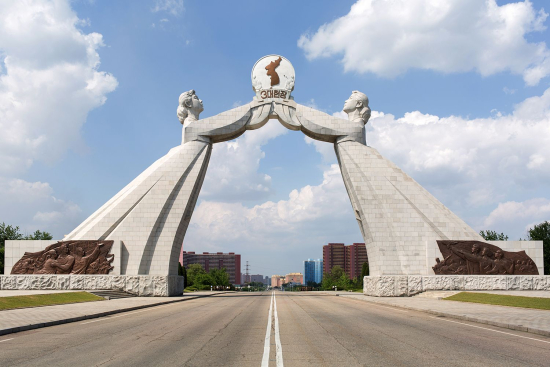
[Photo © Filippo Venturi]
Not any more. After Kim Jong-un's recent declaration that reunification with the South is no longer possible and South Korea has become "the principal enemy", the arch had to go.
Recent imagery from the Maxar WorldView-3 satellite confirmed that the Monument to the Three-Point Charter for National Reunification — a symbol of Kim Il Sung’s dying wish for the reunification of Korea — was demolished and the site wiped clean. Based on the images and satellite images run in overseas media reports, the monument appears to have been torn down methodically rather than blown up….
The monument stood above the Pyongyang-Kaesong highway at the entrance of Reunification Street in the Kwanmun 3 neighborhood of Rangnang District, the gateway to Pyongyang. Completed on Aug. 14, 2001, the arch represented two women — one from the North and the other from the South — holding aloft a map of the Korean Peninsula. It was 30 meters high and 61.5 meters wide, the latter number representing the June 15 North-South Joint Declaration of 2000. The body of the tower was composed of 2,560 granite blocks weighing over 60 kilograms each, while about 740 “memorial stones” sent by groups in the North, South and overseas Koreans adorned the interior of the monument. It also reportedly used precious stones sent by South Korean groups such as Hanchongnyon and the South Korean branch of the Pan-national Alliance for Korea’s Reunification. With North Korea’s demolition of the tower, the noble intentions of Korean groups in both halves of the peninsula and overseas vanished into thin air….
The Monument to the Three-Point Charter for National Reunification symbolized Kim Il Sung’s dying desire for Korean reunification. The Three-Point Charter for National Reunification refers to three items: the July 4 South–North Joint Statement of 1972 that laid out the Three Principles of National Reunification of independence, peaceful unification and great national unity, the “Democratic Confederal Republic of Korea” plan presented during the Sixth Party Congress in October 1980, and the Ten Point Program for Reunification of the Country presented during the Fifth Meeting of the Ninth Supreme People’s Assembly in April 1993.
Daily NK opinion:
South Korean military surveillance assets detected North Korea burying landmines on stretches of the Seoul-Sinuiju road and East Sea road in the DMZ late last year and demolishing dozens of street lamps along these roads. In February, KBS confirmed that remnants of the four-story Inter-Korean Liaison Office in the Kaesong industrial complex were removed. North Korea’s recent string of violations of inter-Korean agreements was confirmed once again in high-res satellite images of the Monument to the Three-Point Charter for National Reunification before and after its demolition. It is hard to gauge the intention and inside story behind these recent actions that suggest a young leader trying to erase the dying wishes and traces of his predecessors, and one worries where this recklessness will eventually go.
Well, the recklessness is nothing new. The fixation on nuclear weapons is surely more concerning than the breakdown of the reunification dream, which was by now inevitable anyway. For Great Leader Kim Il Sung reunification would have involved the triumphant North, a beacon of socialist success, taking in the hopelessly corrupt and decadent South. As it's turned out the South's been resurgent, an economic and cultural powerhouse, while the North's turned into a starvation-ridden dystopian basket case. The only conceivable reunification now would follow the collapse of the Kim dynasty, with the South trying to pick up the pieces – at huge cost.
From North Korea's official point of view, then, reunification has now to be truly dead and buried.
 Mick Hartley
Leave a comment