It's not just Scotland and Wales where they're bravely carrying the torch of the gender revolution against the auld English enemy: we've got a full Celtic rebellion going on here.
Colette Colfer in The Critic – The prison of silence. How the Irish state advances the trans agenda:
The most striking thing about the transgender prisoner situation in Ireland is the silence that surrounds the issue. Most people are unaware that there are male-born prisoners housed in the women’s section of Limerick prison. Most people are also unaware that people can legally change sex in Ireland without having undergone any physical changes to their body. Silence in the public sphere about this topic is being imposed at the government level.
Limerick women’s prison is the smallest prison institution in Ireland, with a bed capacity of just twenty-eight. It is also the country’s most overcrowded, with forty-six prisoners in custody. This means its bed capacity is currently at 164 per cent.
There are currently two transgender prisoners (born male) being housed in Limerick women’s prison. Barbie Kardashian was convicted in May last year of seven counts of threatening to kill. Kardashian was remanded in custody to Limerick women’s prison. Kardashian is due to appear again in court for sentencing on 16 March. Another transgender inmate held in the women’s section had been sentenced to six years and six months in prison after being convicted of ten counts of sexual assault and one count of child cruelty when the child (the prisoner’s stepson) was aged five and six years.
The Irish Independent reported in May 2021 that a third male-born prisoner being housed in the women’s section of the prison had been sentenced to one year in prison for an attack that left a man with a fractured skull and bleeding to the brain.
Although all these prisoners are housed in single cells and kept isolated from other prisoners, the conditions required to ensure prisoner safety for everyone enormously impacts what is an already overcrowded space as well as prison resources.
One woman who had been an inmate in the prison spoke to broadcaster Paddy O’Gorman on Paddy’s Podcast last year. She said the women prisoners did not feel safe even though the transgender inmates were separated from them and had different yard times and meal times too. She said the situation was unfair to the women prisoners and that some of the transgender prisoners shouted at the women from their cells….
Since the passing of the Gender Recognition Act 2015, Ireland’s system of gender self-identification allows people to legally change their gender without medicalisation or a diagnosis of gender dysphoria. Anyone over 18 years of age can change their legal gender by just filling out a form, having it witnessed by a person authorised to take statutory declarations, and then popping the application in the post to the Department of Social Protection with the required documents (generally just a birth certificate)….
Whilst a debate rages in Scotland and the UK more broadly about whether male-born transgender prisoners should be placed in male or female prisons, in Ireland there has never been a public debate. The issue has only rarely been covered in a small number of newspapers or on online outlets.
The culture in Ireland when it comes to gender ideology is one of secrecy and silence. This is partly as a result of a Government stranglehold on the topic through its LGBTI+ National Inclusion Strategy. The strategy involves the introduction of gender ideology to all sectors of Irish society via LGBTI+ ‘training’. The Irish Prison Service is listed as a lead partner in one section of the strategy.
The Irish Prison Service Annual Report 2021 gives details of how, “in keeping with the National LGBTI+ Inclusion Strategy”, the Prison Service prominently flew the rainbow flag during Pride weekend from 26–28 June outside all prisons in Ireland. The report also states that an online presentation was given to prison staff by Transgender Equality Network Ireland (TENI), the main transgender advocacy group in Ireland.
TENI has a representative on the LGBTI+ National Inclusion Strategy Committee, and it is a very influential organisation at Irish Government level despite some controversial stances adopted in recent times. Last year, TENI spoke out against a proposed ban on transgender male-born players in women’s rugby. Guidance developed by TENI in collaboration with IBEC, Ireland’s largest lobby and business representative group, advises that staff who are uncomfortable sharing toilets with trans colleagues should undergo training.
Here's Barbie Kardashian, looking for all the world like an outtake from a cheap horror film.
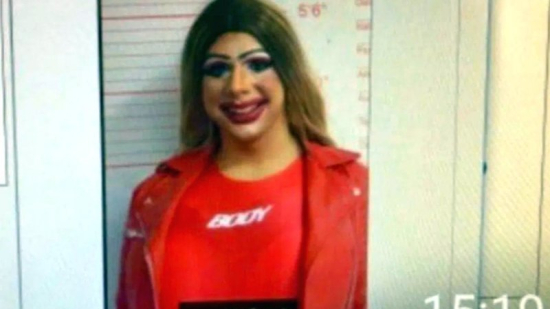
From the Change-org petition to Remove Barbie Kardashian From Limerick Women's Prison:
Barbie Kardashian, a biological male who’s had no hormone treatment or surgery, and has sworn to kill and rape women, has been placed in a women’s prison by the Irish authorities.
Barbie was arrested in Limerick on the 24th of September [2020] for threatening to kill two people, one of them her mother. The story of her arrest became a matter of national media attention after it was revealed that Barbie is a transgender woman, and that her solicitor had told a court that, following her arrest, Barbie was “very anxious she be detained in a prison facility for females.” Her solicitor did not mention that Barbie also has a well-known, and often stated, desire to rape, torture, abuse, and kill women.
A High Court order directing media not to mention her status as a transgender woman only ensured that, Barbie’s gender, and the access that might give her to vulnerable women, was going to become the focal point of the story.
Legally, Barbie is a woman, although it is not clear when she formally changed her gender through a gender recognition certificate. It’s not a procedure that takes much time; under Irish law all you need is to make a declaration that you want to live your life as a particular gender, a birth certificate, and proof of address – it requires about the same amount of effort as opening a bank account. The process used to be more involved and require the involvement of doctors and experts, but that was changed in 2015 with the introduction of the Gender Recognition Act which allowed individuals to merely “self-identify” as a particular gender.
Barbie is understood to have undergone no hormonal or surgical intervention to change her body, but merely “self identifies” as a woman. Clinicians have expressed doubt that Barbie suffers from gender dysphoria at all.
Barbie's now been forgotten. But she's still there – as are the other poor women prisoners in Limerick jail.
 Mick Hartley
Leave a comment