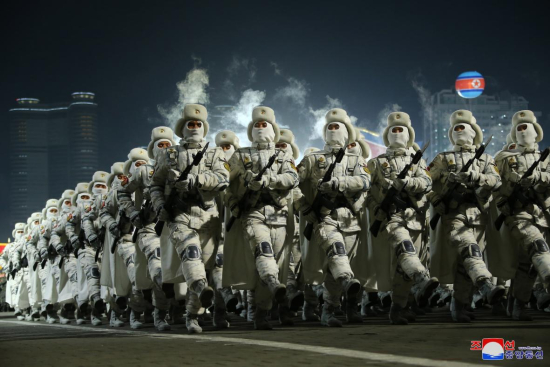
A parade marked the 75th anniversary of the founding of the Korean People’s Army took place in Pyongyang in the early hours of Wednesday morning.
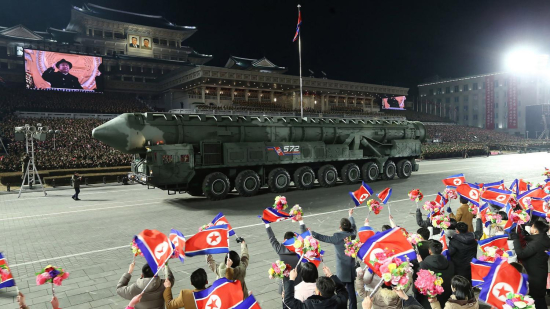
Images on the Korean Central News Agency (KCNA) showed at least 11 of the intercontinental ballistic missile known as the Hwasong-17, which, with a range of more than 9,000 miles, has the potential to launch a nuclear attack on the mainland United States.
The large number of missiles suggests that North Korea has the ability to overwhelm US missile defence systems, which would struggle to intercept a mass launch.
The parade also included a new missile, previously unknown to foreign observers, that appears to be a solid-fuel ICBM. Missiles powered by liquid propellant have to be fuelled shortly before launch, making them vulnerable to pre-emptive attack by an enemy. Solid-fuel engines, on the other hand, can be fired without time-consuming preliminaries.
Five of the new camouflage-painted missiles, which may have been models rather than working weapons, were paraded on vast transporters. They appear to be the result of a test overseen by Kim in December of what was described as a “high-thrust solid-fuel motor . . . the first of its kind in the country”. KCNA reported then that he “gave warm encouragement to its scientists and technicians, expressing the expectation that another new-type strategic weapon would be made in the shortest span of time”.
But it is the long column of Hwasong-17s that will provoke the greatest concern. The US Missile Defense Agency has 44 missile interceptors designed to bring down North Korean attacks. “Assuming that four such interceptors are available for use against each incoming North Korean re-entry vehicle,” wrote Ankit Panda, a nuclear expert at the Carnegie Endowment for International Peace, “North Korea could saturate the existing Ground Missile Defence system . . . with just 11 re-entry vehicles.”
Well that's all very depressing, but I don't think we need to be heading to our nuclear bunkers just yet.
The official Rodong Sinmun, naturally enough, was all over it:
The Korean People’s Army (KPA) has taken the lead in accomplishing the great cause of building up a rich country with a strong army, while displaying its glory and might as the armed forces of the great Workers’ Party of Korea (WPK) that built a powerful socialist country, independent in politics, self-supporting in the economy and self-reliant in national defence, for the first time in the 5 000-year-old history of the nation. 75 years of its heroic struggle are shining in the history of the Juche revolution.
The KPA, which inherited the revolutionary traditions of the Anti-Japanese Guerrilla Army as its lifeblood, has covered the steady course of victory, performing brilliant feats in the struggle to defend the country and the people while regarding the absolute loyalty to the idea and leadership of the WPK as a duty for its existence and development. And it has developed into the iron fist of Juche Korea and entity of the tremendous national power which has placed our country in the front rank of world powers.
A grand military parade was held at Kim Il Sung Square in the capital city of Pyongyang on Feb. 8 to celebrate the 75th founding anniversary of the KPA, the revolutionary armed forces of the WPK.
At the parade venue where the birth of the regular armed forces, the soul and symbol of an independent and sovereign state, was declared, the KPA made the first stride towards attaining the goal of becoming an elite army with its sacred mission and grand ambition, amid the enthusiastic cheers and great expectation of all the people.
Our young regular armed forces developed into the most powerful entity that stockpiled overwhelming force capable of successfully frustrating the arbitrary practices of the imperialists, by building up their capabilities with the red idea and self-reliance in the arduous and protracted course of the revolution thanks to the WPK’s original self-defensive military idea and distinguished leadership. Today they will enter the square of significant parade celebrating the 75th birthday of the KPA, demonstrating their tremendous strength to the whole world…
And so on..and on..and on. Even by their standards, this is a remarkably long piece of windbaggery. Click on the photo link and there are an unprecedented 150 images. So they see this as a very big deal.
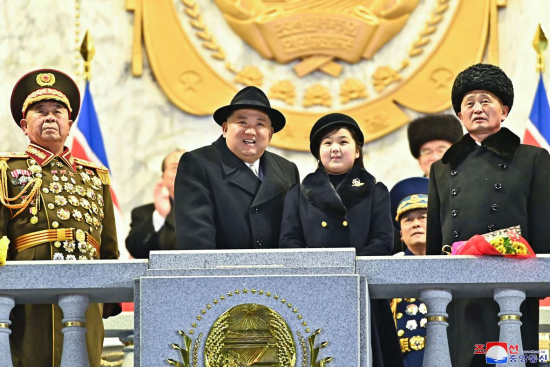
Does the presence of Kim Jong-un's daughter (middle picture) signify that she's being presented as his likely successor? I posted an article from the Daily NK back in December, when she first appeared in public, which argued against this interpretation:
“The daughter revealed to the public cannot become the successor. If she were to be the successor, she wouldn’t have been shown holding her father’s hand or being carried like a child,” another high-ranking source told Daily NK.
Idolization consists of the process of deifying a leader who was born with unique qualities that set them apart from the masses. Therefore, the leader being idolized cannot be depicted as a weak child in need of protection, the source said.
After Kim Jong Un took power, mythical anecdotes were circulated that he had shot his first gun and driven his first car at the age of three as part of efforts to idolize him.
Senior cadres inside North Korea currently take it for granted that Kim’s successor will be his firstborn son. But because the successor must already be a fully capable adult at the time of his debut, he will be kept in complete secrecy until then, the source explained.
One of the apparent reasons that Kim brought his daughter along for two politically significant events related to North Korea’s nuclear arsenal is to underline that all members of his bloodline possess a superiority that sets them apart from the general public.
“The aged commander bowed low for a handshake, but [Kim’s] ten-year-old daughter didn’t bow. That shows that the leader’s children must be treated with the same veneration as the leader himself,” the first high-ranking source told Daily NK.
 Mick Hartley
Leave a comment