An interview in the Telegraph with Riley Gaines, an American swimmer who's devoting herself to the issue of fairness in women's sport:
Eight months after she raced against Lia Thomas, the transgender swimmer who ignited a global firestorm by winning a national female collegiate title in the United States, Riley Gaines still feels a searing sense of injustice.
“It felt,” she says, “like heartbreak. Women had dedicated their entire lives to this. We had spent 5½ hours every day in the pool. To have it taken away from you by somebody who, only a year earlier, would never have even qualified for this competition as a man? It was a total slap in the face.”
But the indignities she felt were only just beginning. The day after she watched Thomas – who until starting hormone therapy was ranked a mere 554th as a man – vanquish every female rival in the country, she found that they would be direct competitors in the 200-yard freestyle final. They finished, ultimately, in a dead heat for fifth.
Except, only Thomas was allowed to hold the fifth-place trophy, with Gaines told by an official that it was “for photo purposes”. She would need, she was told, to make do with the award for sixth.
A telling photograph captured the chaotic scene at those finals in Atlanta, a moment to symbolise the trans controversy that is threatening to tear sport apart. While Thomas cradled her trophy, staring dead ahead, Gaines, as recipient of the inferior trophy, spread out her hands in incredulity.
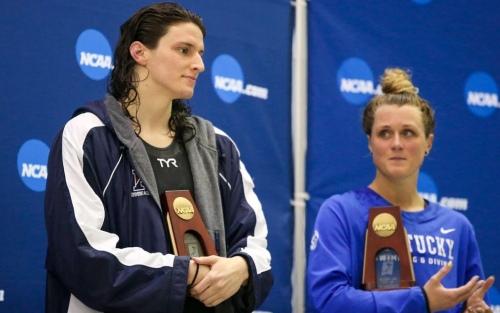
[Photo: USA Today Sports]
“I was saying how it was wrong,” she reflects. “I asked the officials, ‘You’re seriously going to give this trophy to a biological male over a woman?’ This is b——- and you know it. This person won a national title last night, and here you are disadvantaging women at a women’s event. Thomas didn’t say a word, didn’t offer the trophy. It suggests to me a lack of self-awareness, plus disrespect towards the female athletes. I think it shows a lot of narcissism.”
Yep. That photo: he's very pleased with himself. And totally oblivious to Gaines, the woman he's robbed.
Thomas became emblematic of many sports’ efforts, in defiance of compelling scientific literature, to incorporate trans athletes into the female category. Here was a swimmer who carried all the cardiovascular advantages of male puberty, but who could, with a short course of testosterone suppression, compete against women at the highest levels in America.
“People will say, ‘Oh, she just transitioned, so she would have an advantage,’” Thomas said in May. “I transitioned to be happy.”
“This was somebody who came out of nowhere,” Gaines says. “Typically, as a top athlete, you know all your rivals. It was then disclosed that Lia Thomas was actually Will Thomas, who had swum on the men’s team at the University of Pennsylvania for three years.
“Honestly, when I heard this I was pretty relieved. I thought, ‘Oh, this makes sense. There’s no way Thomas will be allowed to compete with women.’ But two weeks before we were due to race in the finals, we learned Thomas would be there. There was a state of shock. To my team-mates and my coaches, there was an obvious reason why this was wrong and unfair.”
Gaines was an extreme rarity in that she was prepared to put a name to her concerns.
“Women are intimidated by their universities,” she says. “They’re told that they will never get into graduate school, that they will never get a job. The women are emotionally blackmailed, told that if trans athletes emotionally harm themselves after someone speaking out, then they are solely responsible. It’s a lot to put on 18- to 22-year-olds.”
Nowhere were these tensions more vividly played out than in the locker room. Kim Jones, the mother of one of Thomas’s fellow competitors, protested vigorously against the presence of a biological male in female changing facilities, only to receive an email from the Ivy League saying that anyone who objected was advised to seek counselling.
“In the locker room, you’re comfortable for the most part being half-naked. It’s not necessarily a place of modesty. But it is a place where you don’t have to feel vulnerable.
“We were not forewarned about Thomas sharing our space. That’s absolute insanity to me. All of a sudden, the place goes silent and there’s a 6ft 4in biological male towering over everyone else, starting to undress. You feel this sense of total discomfort. It was the most bizarre experience. I walked out of there thinking, ‘Am I missing something? Why are people in authority not talking about how this is wrong?’”
It's a good question. People are generally too intimidated to speak out – but there'll always be a few brave souls, like Gaines here.
And the problem isn't going away.
In New Zealand just last week, Kate Weatherly, a transgender cyclist who had barely featured in the male ranks, won a major endurance race. It is but the latest example of a trend that convinces Gaines she is fighting a noble cause.
“Opportunities are being taken away,” she says. “One girl being disadvantaged is one too many."


 Mick Hartley
Leave a comment