It's not only a matter of "re-education camps" and forced sterilisation: the cultural genocide being waged by the Chinese against the Uighurs also involves the physical erasure of their holy sites. From the NYT:
The Chinese authorities have in recent years closed and demolished many of the major shrines, mosques and other holy sites across Xinjiang that have long preserved the culture and Islamic beliefs of the region’s Muslims.
The effort to close off and erase these sites is part of China’s broader campaign to turn the region’s Uighurs, Kazakhs and members of other Central Asian ethnic groups into loyal followers of the Communist Party. The assimilation drive has led to the detention of hundreds of thousands in indoctrination centers.
The new report by the Australian Strategic Policy Institute, a research group based in Canberra, systematically gauges the degree of destruction and alteration to religious sites in recent years. It estimated that around 8,500 mosques across Xinjiang have been completely demolished since 2017 — more than a third of the number of mosques the government says are in the region.
“What it does show is a campaign of demolition and erasure that is unprecedented since the Cultural Revolution,” said Nathan Ruser, the researcher at the institute who led the analysis. During the decade-long turmoil that unfolded from 1966 under Mao Zedong, many mosques and other religious sites were destroyed. […]
Large shrines are often gravesites of imams, merchants and soldiers who spread Islam in the region over a thousand years ago. Some are imposing complexes built and rebuilt over the centuries. But a tree or pile of stones can also serve as a shrine, marking a holy presence for villagers.
At Ordam, a famed shrine in the desert of southern Xinjiang, pilgrims had been gathering for more than 400 years years to celebrate the memory of a leader who brought Islam to the region and fought a rival Buddhist kingdom.
“If you have a donkey and a cart, you load up your food and you spend three weeks to get to a shrine,” said Rian Thum, a researcher at the University of Nottingham who has studied Ordam and other shrines and their fate. “The only place I’ve seen a grown Uighur man cry was at a shrine.”
But in the 1990s, the Chinese government grew increasingly nervous about the expansion of mosques and revival of shrines in Xinjiang. Officials saw the gathering of pilgrims as kindling for uncontrolled religious devotion and extremism, and a spate of antigovernment attacks by discontented Uighurs set the authorities on edge.
The authorities banned festivals and pilgrimages at Ordam in 1997, and other shrines closed in the following years.
Still, some visitors and tourists crept in to visit.
“One Uighur who had managed to visit Ordam told some of the villagers nearby that she had been, and they started weeping and one asked for some dust from her jacket,” Mr. Thum recalled. “This gives a sense how important this place is to people, even when they cannot visit.”
The previous closures and bans on visits to the shrines were a prelude to a more aggressive campaign by the government.
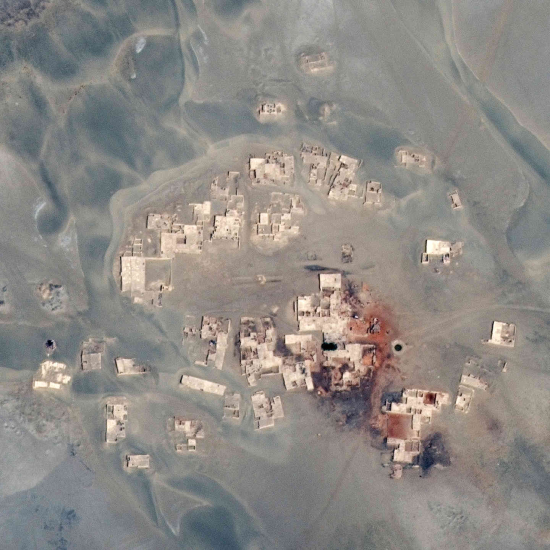
By early 2018, the Ordam shrine, isolated in the desert and almost 50 miles from the nearest town, had been leveled, eradicating one of most important sites of Uighur heritage. Satellite images from that time showed the shrine’s mosque, prayer hall and simple housing where its custodians once lived had been razed. There is no news of what happened to the huge cooking pots where pilgrims left meat, grain and vegetables that custodians of the shrine cooked into holy meals.
Satellite images of the Ordam shrine from May 2011:
and Oct 2018:
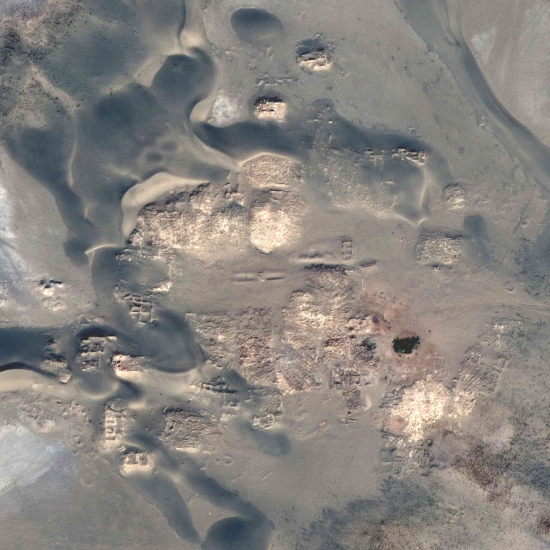
[Satellite images by Maxar Technologies]
 Mick Hartley
Leave a comment