North and South Korea are in the same group for the 2nd round of the Asian qualifier for the 2022 FIFA World Cup in Qatar. On Tuesday they met in Pyongyang. A huge match for both countries, you'd think. Remember those cheering crowds when the South Koreans made it to the World Cup before. And here, against North Korea!
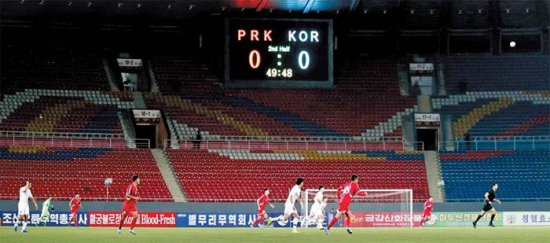
But they played out a miserable untelevised goalless draw in an empty stadium:
The rare match — the first inter-Korean face-off on North Korean soil in almost three decades — took place in an empty stadium, creating a bizarre experience for fans trying to follow it online.
Both South and North Korea now have two wins and a draw in their group, which also includes Lebanon, Sri Lanka and Turkmenistan. However, South Korea leads on goal difference, by 10 to 3.
In what turned out to be an anti-climax after much pre-game excitement, the match was held in bizarre circumstances, lacking a live broadcast, fans or media presence. The North did not allow the match to be broadcast, and denied entry to South Korean media. Those concerned, like officials from the Korea Football Association, media outlets and football fans, had to make do with brief updates on FIFA and the Asian Football Confederation's websites….
The South Korean players, who braced themselves to play before for a huge crowd of spectators cheering on the North Korean squad, were surprised to find the stands empty. "It was the opposite of how we pictured it, because North Korea told us a day before the match that some 40,000 people would come," a KFA official said.
Some China-based tour agencies specializing in trips to North Korea sold package tours to Pyongyang including admission tickets to the match, but they apparently canceled the tour programs.
So what happened? It could've been a source of considerable revenue for the cash-starved North Korean regime. But that's not how it works. The Daily NK spoke to "a source from Pyongyang":
Q: Did North Korea have any intention to broadcast the Tuesday match live?
A: You can bet that North Korea never had any intention of broadcasting the soccer match between North and South Korea in the first place. The situation would be no different whatever large sum of money South Korean broadcasters might have been willing to pay for the broadcasting rights. The point is that North Korea does not want to be watched live by others around the globe. If relations between North and South Korea had improved to an exceptional degree, and the Supreme Leader (Kim Jong Un) magnanimously decided to allow broadcasts, it could’ve happened, especially because Kim would’ve been able to pocket the profits from the broadcasting fees. Even if the match had been broadcast in South Korea, however, North Korea would never have broadcast the match live on North Korean TV.
The reason for this is that they know that the North Korean soccer team is weaker than South Korea’s team. If North Korea was to lose, the country’s leaders would be embarrassed. This is why a live broadcast would never have been allowed. If North Korea happened to win, then North Korean leaders would happily release a recording of the match. Ultimately, what they’re worried about is that something unexpected could happen and be broadcast to the globe.
Q: Traditionally, matches officiated by FIFA are broadcast live. Doesn’t this behavior contradict North Korea’s aspirations and attempts to become a “normal” country?
A: It doesn’t occur to North Korean officials that the broadcasting of the soccer match impacts their claims to be a normal country. It is also difficult for North Koreans to complain about the lack of a live broadcast. A lot of North Koreans probably take it for granted that such games will never be broadcast live. Even the international community hasn’t really raised an issue about North Korea failing to permit a live broadcast of the match. What kind of North Korean sports official, then, would stick out his neck and propose that the match be broadcast live?…
Q: North Korea refused to let in South Korean press and broadcasters, and even South Korean cheerleaders. Why was this the case?
A: The most important reason is that North Korean officials worry about the enthusiastic cheering of the South Korean cheerleading team. Even if there are only a few of them, their heartfelt cheering would surely shock North Koreans.
North Korean society would be all abuzz with talk about every little aspect of the South Korean cheerleading team, including, of course, their cheerleading accessories and outfits. Allowing in the South Korean cheerleading team would essentially be opening the door to an image of South Korea that North Korea has tried to keep out.
Q: On the other hand, the North Korean cheerleading team has attended matches hosted in South Korea multiple times. It is quite a contrast.
A: When our cheerleading team visits the South, it is presented as a “war for communism on enemy territory.” Only members of the elite who have undergone an intense process of indoctrination are nominated to go.
What is frustrating is that when our cheerleading team goes to the South, the South Korean authorities do not place any conditions on them and provide every convenience free of charge.
Shouldn't FIFA make live broadcasting a requirement of participation in the World Cup? Why not?
At least, with the state of North Korea's finances, it's unlikely that FIFA have been influenced here by large amounts of cash finding their way into the bank accounts of high-ranking officials. Which makes a change.
 Mick Hartley
Leave a comment