The assassination of Andrei Karlov, the Russian ambassador to Turkey, in an Ankara art gallery on December 19 2016, was chiefly memorable – as I wrote at the time – for the excellent quality of the photographs. In particular, this dramatic image of killer Mevlüt Mert Altıntaş standing over the body of his victim:
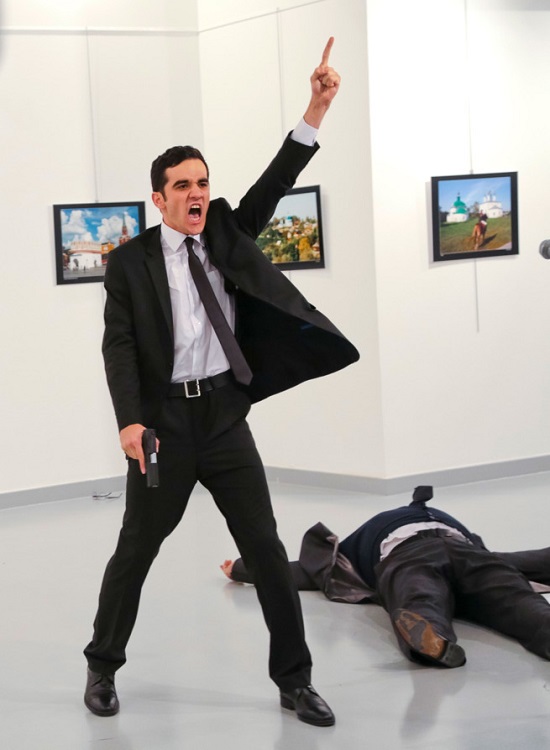
The picture, by Burhan Ozbilici, was voted World Press Photo of the Year.
The killer was shot dead by Turkish police. He'd shouted "Allahu Akbar. We are the descendants of those who supported the Prophet Muhammad, for jihad. Do not forget Aleppo, do not forget Syria" and "We die in Aleppo, you die here". Clearly – you'd have thought – he was motivated by a desire for revenge against the Russian military involvement in the killings in Aleppo, and the slaughter of Muslims by infidels. The attack was praised by ISIS and al-Qaeda affiliated accounts on social media.
For Turkish president Recep Erdoğan, though, this was yet another plot against him. With his trademark paranoid style, any event can be twisted and turned into a conspiracy, usually involving arch-enemy Fethullah Gülen. Thus 28 defendants now find themselves charged with roles in the assassination, in a trial which opened yesterday:
Turkish prosecutors concluded that a network led by Muslim cleric Fethullah Gulen was behind Karlov's slaying and the attack was meant to derail warming ties between Turkey and Russia.
They have charged 16 of the defendants, including Gulen, with "violating the constitutional order," ''membership in a terror organization" and "premeditated murder with the intention of causing terror." Prosecutors are seeking life prison sentences for those convicted.
Twelve others face maximum 15-year terms on charges of membership in a terror group.
Gulen, who has lived in the United States since 1999, has denied involvement in the coup or the Russian diplomat's assassination.
Other defendants include former police officers, the photo exhibit's organizer, a former Turkish intelligence agent and a former Turkish newspaper columnist who also now lives in the United States….
Fourteen of the defendants appeared in court on Tuesday, while four others were connected to the courtroom by a video link from separate prisons. Gulen and several others are being tried in absentia.
Six of the defendants, including ex-police officers who attended the same police academy as the gunman, gave testimony Tuesday. They denied links to Gulen.
A court in April issued arrest warrants for Gulen and seven other people in connection with the killing. Turkey is seeking Gulen's extradition from the United States.
 Mick Hartley
Leave a comment