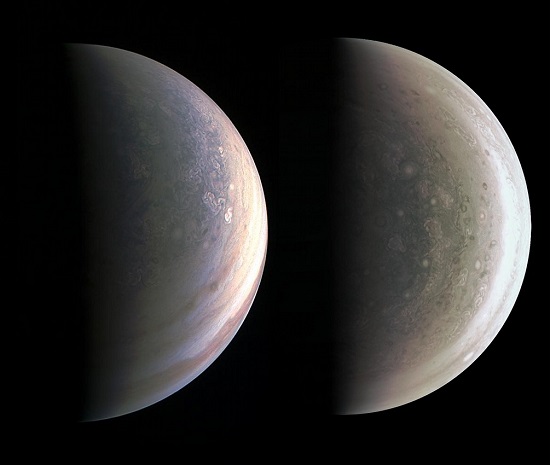
More dramatic images of Jupiter from Juno:
[Image Credit: NASA, JPL, Juno Mission]
"A wide, looping orbit brought Juno close to Jupiter on August 27. As the spacecraft swung around the giant planet's poles JunoCam acquired these premier direct polar views, a change from the usual nearly equatorial perspective of outbound spacecraft and the telescopes of planet Earth. The sunlit side of Jupiter's north polar region (left) was imaged about 125,000 kilometers from the cloud tops, two hours before Juno's closest approach. An hour after close approach the south polar region was captured from 94,500 kilometers away. Strikingly different from the alternating light-colored zones and darker belts girdling more familiar equatorial regions, the polar region clouds appear more convoluted and mottled by many clockwise and counterclockwise rotating storm systems. Another 35 close orbital flybys are planned during the Juno mission."
But let's not forget NASA's Curiosity Rover, still pottering about on Mars, and still sending back amazing images:
[Image: JPL-Caltech / MSSS / NASA]
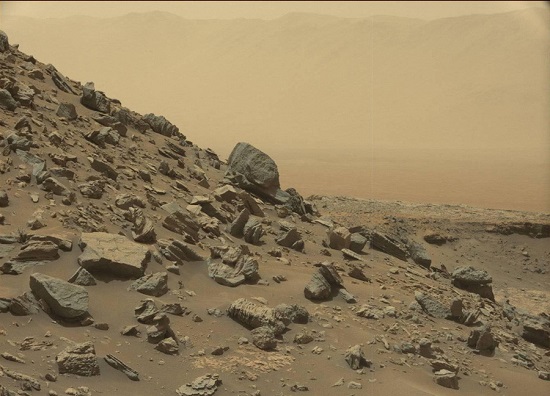
"This view from the Mast Camera (Mastcam) on NASA's Curiosity Mars rover shows a sloping hillside within the "Murray Buttes" region on lower Mount Sharp. The rim of Gale Crater, where the rover has been active since landing in 2012, is visible in the distance, through the dusty haze. The image was taken on September 8, 2016."
[Image: JPL-Caltech / MSSS / NASA]
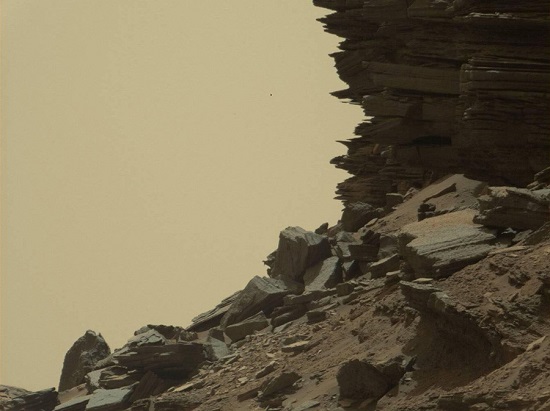
"This view from the Mast Camera (Mastcam) in NASA's Curiosity Mars rover shows a hillside outcrop with layered rocks within the "Murray Buttes" region on lower Mount Sharp. The buttes and mesas rising above the surface in this area are eroded remnants of ancient sandstone that originated when winds deposited sand after lower Mount Sharp had formed. Curiosity closely examined that layer — called the "Stimson formation" — during the first half of 2016, while crossing a feature called "Naukluft Plateau" between two exposures of the Murray formation. The layering within the sandstone is called "cross-bedding" and indicates that the sandstone was deposited by wind as migrating sand dunes. The image was taken on September 8, 2016."

 Mick Hartley
Leave a comment