On my first visit to the new Saatchi Gallery last year, I was impressed. Nothing about my second visit, today, made me change my mind. It's a wonderfully open, airy, welcoming space. Already, coming through the doors, you feel charged up, ready to enjoy whatever's on offer. Of course it helps that admission's free – you can pay £1:50 if you want for a picture by picture guide – but for me it just emphasises how dreary most of London's other main galleries are by comparison.
On show, Abstract America. It got fairly mixed reviews when it opened, I think, which seems fair enough. As you'd expect with this kind of portmanteau exhibition, there's some good and some not so good. I liked Kristin Baker (The Unfair Advantage for instance), Bart Esposito,, and this by James Wood:
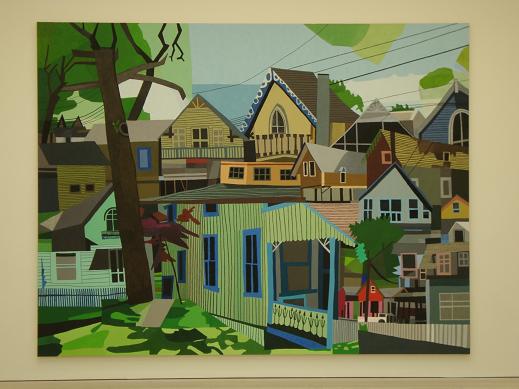
- not at all what I'd call abstract, but never mind.
And this:

Sterling Ruby's lascivious Kiss Trap Kismet.
It's not only the pictures themselves though: it's the joy of being in an empty gallery…
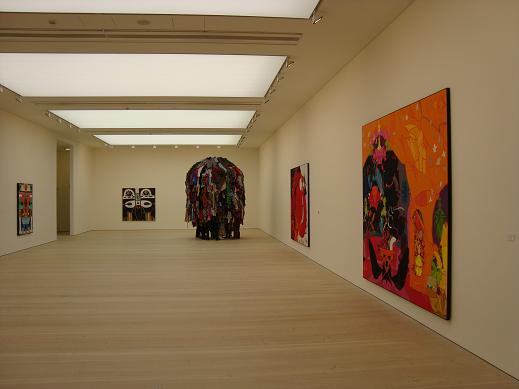
That thing in the middle there? That's this.
And there's always the other people:
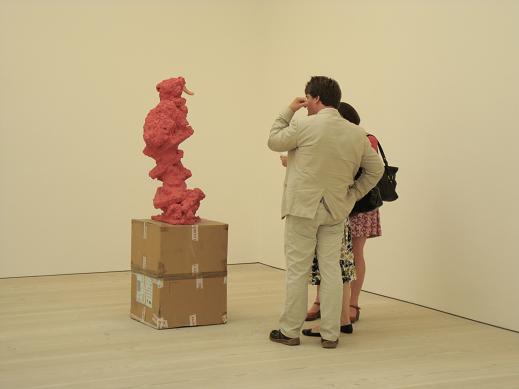
It's a nose! Getting to grips with Rachel Harrison.
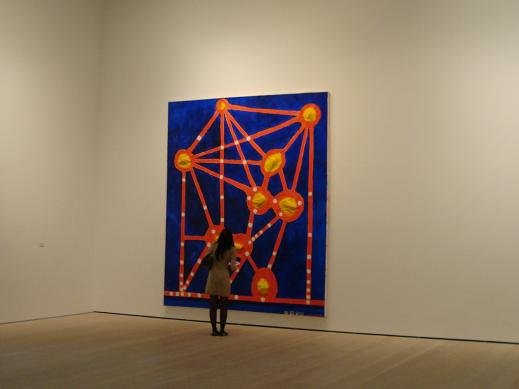
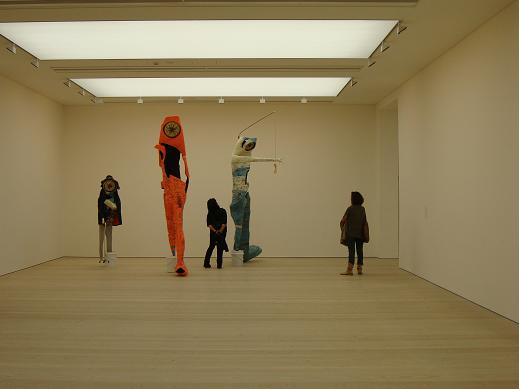
and Ryan Johnson.
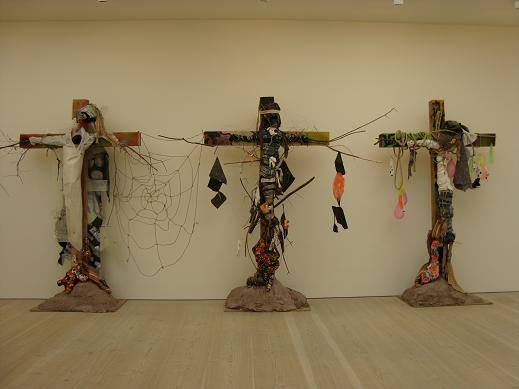
Within Snow’s work is the intrinsic value of creative methodology and material negotiation, the infusion of her idiosyncratic interpretation and belief into the structures she assembles. The making of Snow’s sculptures is an intensely physical process, and for this series of work she created each piece in the gallery where it was originally exhibited, inhabiting the space for the duration of the show. This performative dimension of her work is evidenced in the finished pieces, such as Five (Cross On The Left With Spider Web), which expose her modes of assemblage, spontaneous decision making, and playful innovation, transforming simple objects such as used clothing and twigs into totems of artistic creation and fictionalised degeneracy.
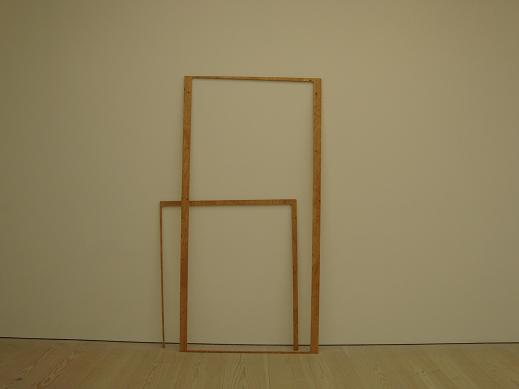
In addition to minimalism, Sibony also cites inspiration from Robert Rauschenberg’s combines and Richard Tuttle’s post-minimalism in his synthesis of disparate media, and the arte povera movement in its approach to experimentation and mystical conception of the natural quality of materials. Side Show, Side Show is a deceptively simple arrangement of two wooden frames leaned against the wall, establishing a contingent relationship to both each other and the surrounding gallery architecture. Delineating empty space as a comparable field by which to measure the sculpture’s existence, Side Show, Side Show wittily hovers between ‘being’ and ‘nothingness’, exuding a quiet spiritual aura in its delicate self-assertion. Presented with understated elegance, the frames operate as both a form and its shadow, action and consequence, a receptacle and echo of viewer perception.
 Mick Hartley
Leave a comment